What Moonvalley is
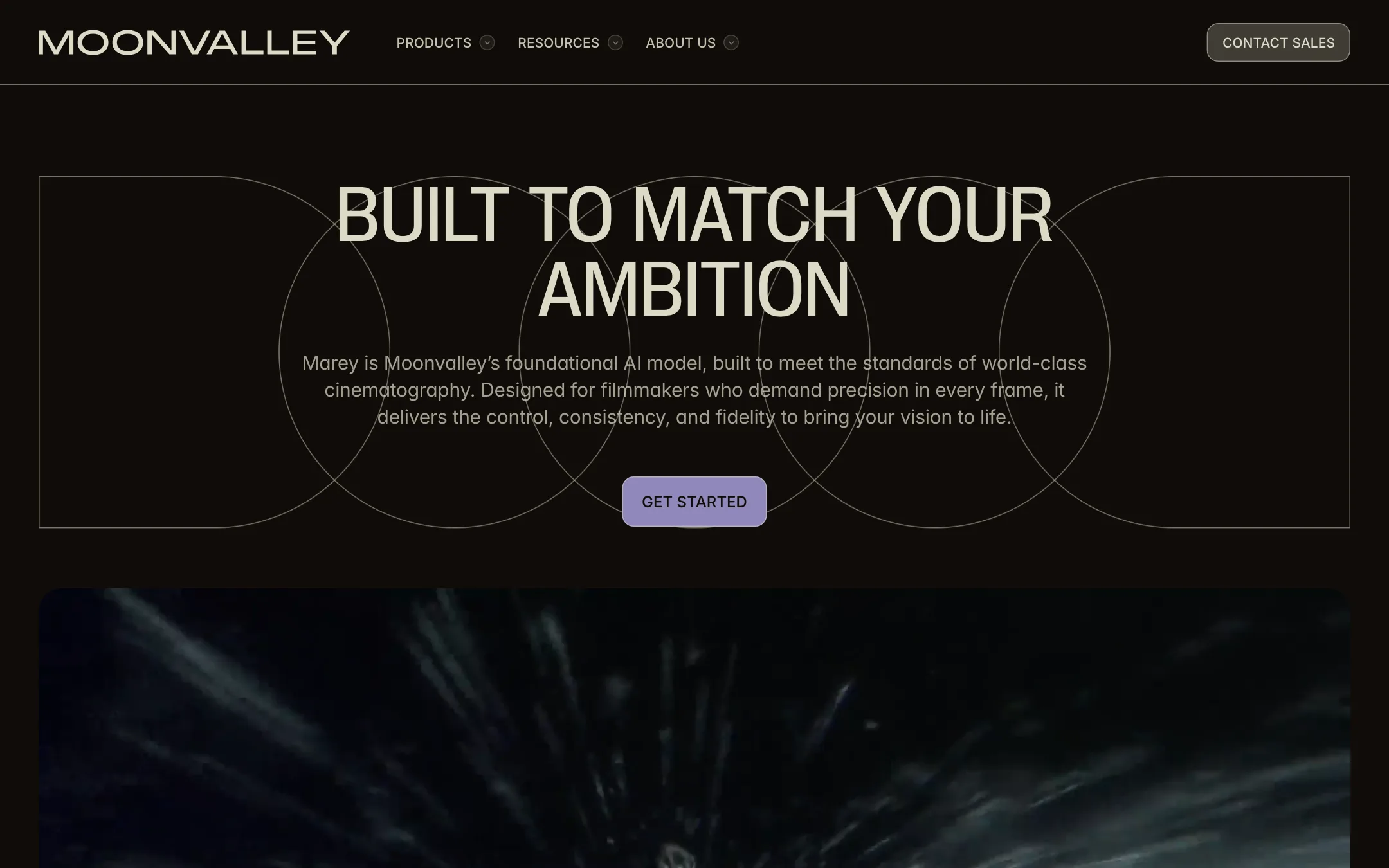
Moonvalley is an AI research lab that builds video models for filmmakers. Its model is called Marey. It generates video from text or from an image, and it comes with a set of controls designed around how directors work: camera moves, motion transfer, drawn trajectories, keyframes, pose control and shot extension.
Moonvalley’s main selling point is the training data. It says Marey is “the world’s first commercially safe video model,” trained only on licensed, high-resolution footage with “no scraped content” and “no user submissions.” At launch in July 2025 that pitch earned coverage from Deadline, TechCrunch and Fast Company.
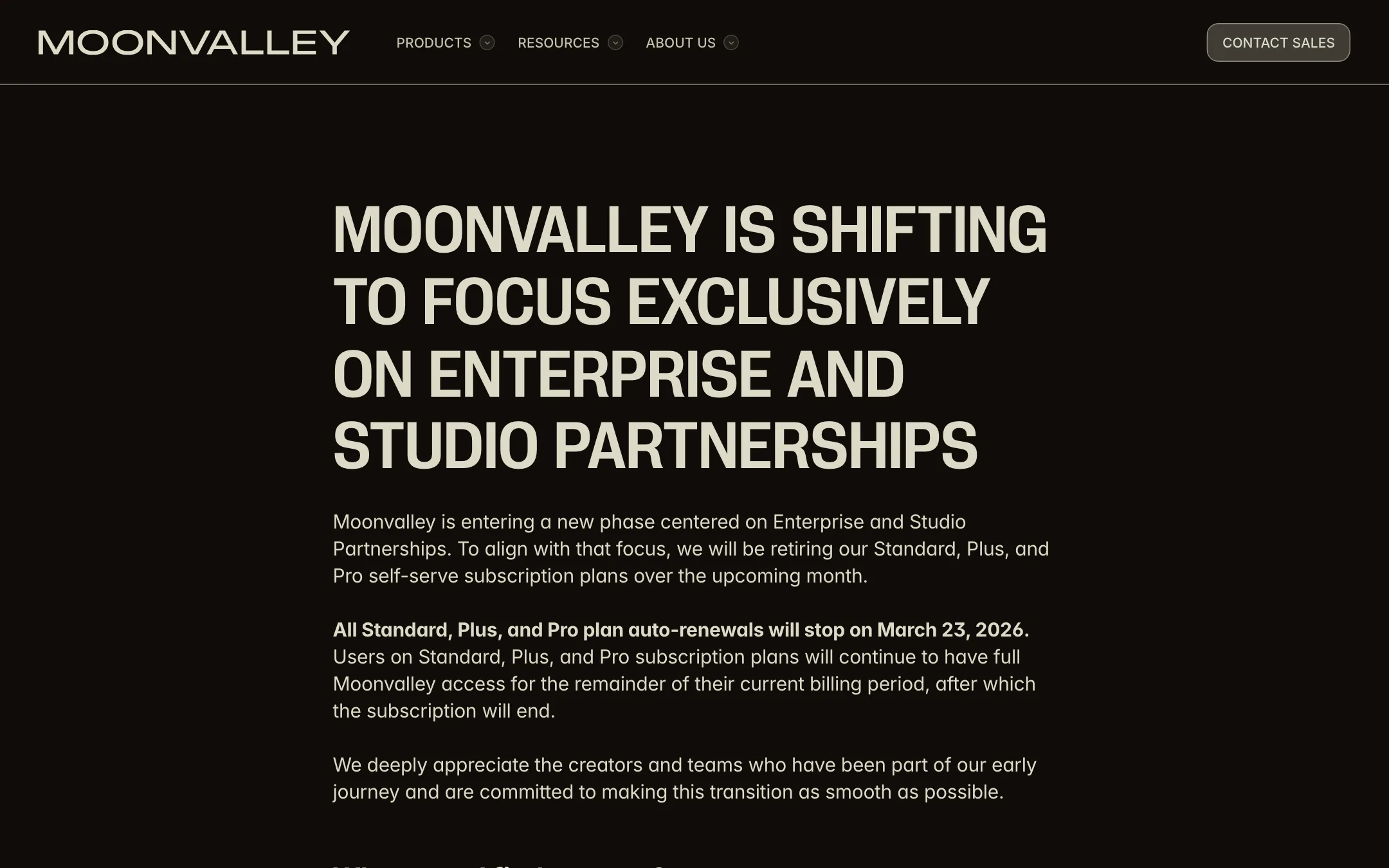
There is a big caveat for creators. In 2026 Moonvalley shifted to “focus exclusively on Enterprise and Studio Partnerships.” It retired its Standard, Plus and Pro self-serve plans, and auto-renewals stopped on March 23, 2026. If you are a solo creator, you cannot sign up for the Marey app anymore.
Who it is for
Moonvalley fits you if:
- You work at a studio, agency or brand that needs AI video with a clear licensing story for legal review.
- You care about precise camera and motion control more than templates or effects.
- You build pipelines in ComfyUI or call models through fal.ai.
Skip it if:
- You are a solo creator who wants an app with a monthly plan. That option is gone.
- You want native audio, long clips or social templates. Marey’s public listings focus on short, silent cinematic shots.
- You want a free tier to experiment. There is none.
How it works
Moonvalley’s own app is now limited to enterprise and studio partners. For everyone else, there are two routes to Marey.
Through fal.ai
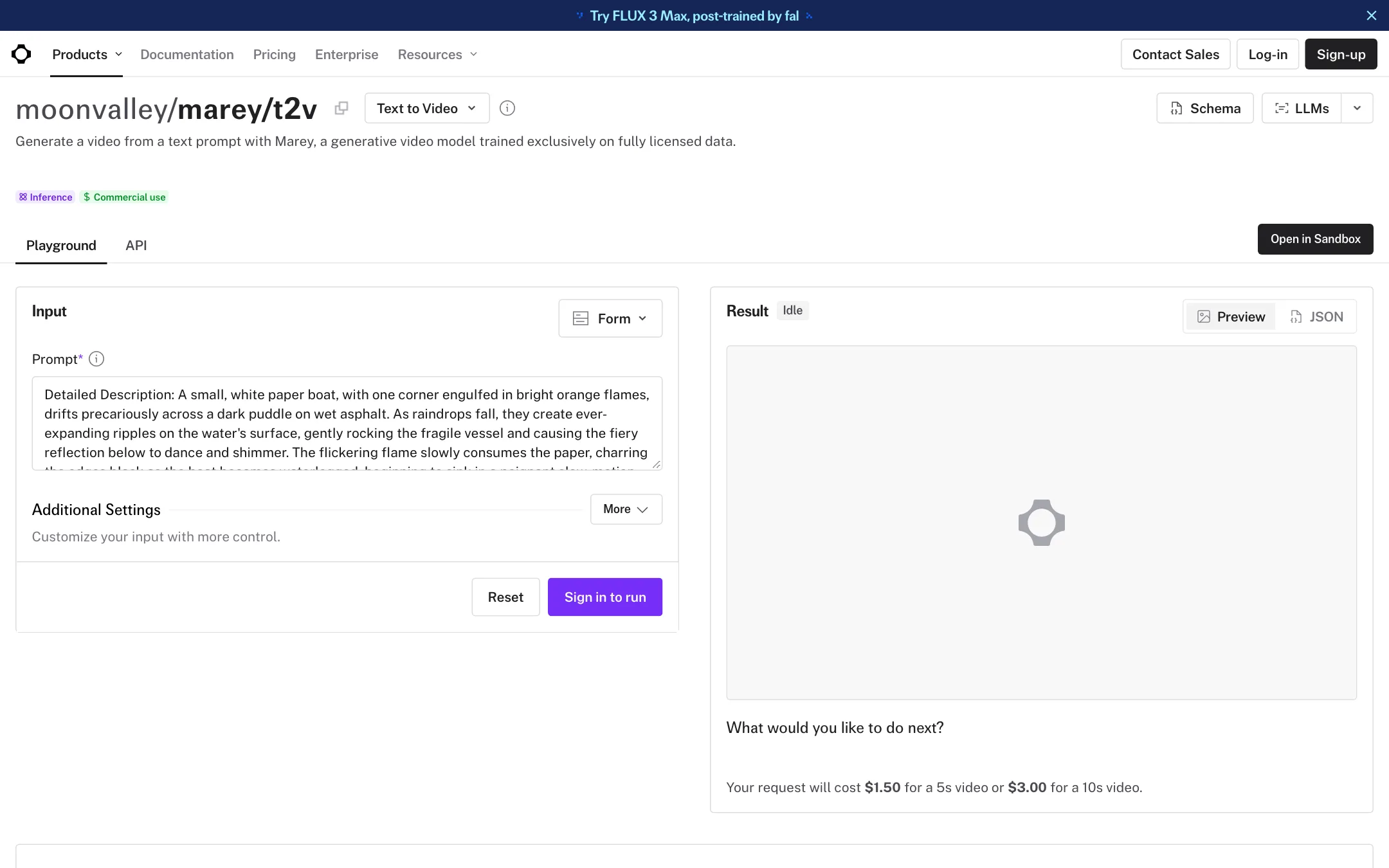
fal.ai is a model hosting platform. Its Marey text-to-video endpoint takes a prompt, a duration of 5 or 10 seconds, a frame size (1920x1080 by default), a negative prompt and a seed. The fal page recommends prompts of at least 50 words that cover camera, environment, subjects and action. You pay per clip.
Through ComfyUI
ComfyUI offers Marey Realism as native API nodes. If you already build node-based workflows, you can drop Marey in next to other models, image tools and upscalers.
The controls
Moonvalley’s Marey page describes these controls. Not every control is exposed on every third-party endpoint, so check what your route supports.
- Camera control: start from a single image and move the camera through it as if it were a 3D set.
- Motion transfer: take the movement from a reference video and apply it to a new subject or scene.
- Trajectory control: draw a path for any element and Marey moves it along that line, with no prompt rerolls.
- Keyframing: place several reference images on a timeline and Marey generates the transitions between them.
- Reference: give each character or object its own reference image.
- Pose control: guide a performance from reference images, video or performance input.
- Shot extension: continue a clip while keeping its motion and scene.
A typical fal.ai run
- Write a 50-word or longer prompt naming the camera, setting, subject, action and light.
- Set duration to 5 seconds while you test.
- Leave the frame at 1920x1080 or pick another size.
- Add a negative prompt for things you do not want, such as text or extra limbs.
- Fix the seed once you like a result, so you can vary the prompt and compare.
- Move to 10 seconds for the keeper.
Prompting Marey well
The fal.ai page asks for long prompts, and that advice fits how Marey is pitched. A few habits help with any cinematic model, and they matter more when you pay per clip:
- Write like a shot list. Name the lens feel, the camera move, the subject, the action and the light in that order.
- Describe one action. Five or ten seconds is enough for one clear beat. Two or three actions in one prompt usually blur together.
- Use the negative prompt. List what you keep getting and do not want, such as text overlays, extra people or jitter.
- Lock the seed when comparing. Change one word at a time so you can see what each change does.
- Test at 5 seconds. At $1.50 a try, a few drafts cost less than one wasted 10-second render.
Output quality
Moonvalley makes strong claims about Marey: prompt adherence with “no drift,” detail that holds up “in grading, playback, and on screens that show everything,” natural physics, fluid motion and lighting continuity “like it was lit on set.” These are vendor claims. We have not tested Marey hands-on, and Moonvalley does not cite an independent benchmark on its pages.
What sets Marey apart is less raw quality than control and provenance. Drawing a trajectory or transferring a performance is closer to directing than prompting. And a model trained on licensed footage is easier to clear for a client or a studio.
Keep two limits in mind. First, “commercially safe” describes the training data. It does not mean every output is cleared. If you prompt a famous character or upload someone else’s footage as a reference, the risk is yours. Second, the public listings we found make no mention of native audio, which several competing models now generate with the video.
Pricing
Moonvalley no longer publishes a price for direct access.
| Route | Price | Notes |
|---|---|---|
| Enterprise and studio | Contact sales | Apply through the Partner with us form |
| fal.ai | $1.50 per 5s, $3.00 per 10s | Text-to-video at 1080p by default |
| ComfyUI | Per ComfyUI API pricing | Marey Realism nodes |
| Standard, Plus, Pro | Retired | Renewals stopped March 23, 2026 |
The old self-serve plans, still described in Moonvalley’s help center and on third-party sites, were Standard at $14.99 a month, Plus at $34.99 and Pro at $149.99, with each generation costing 10 credits. Treat those as history.
At $0.30 a second on fal.ai, Marey is not the cheapest model per second. Some popular models on the same platform start at a third of that. You are paying for the licensing story and the controls.
Contradictions on Moonvalley’s own site
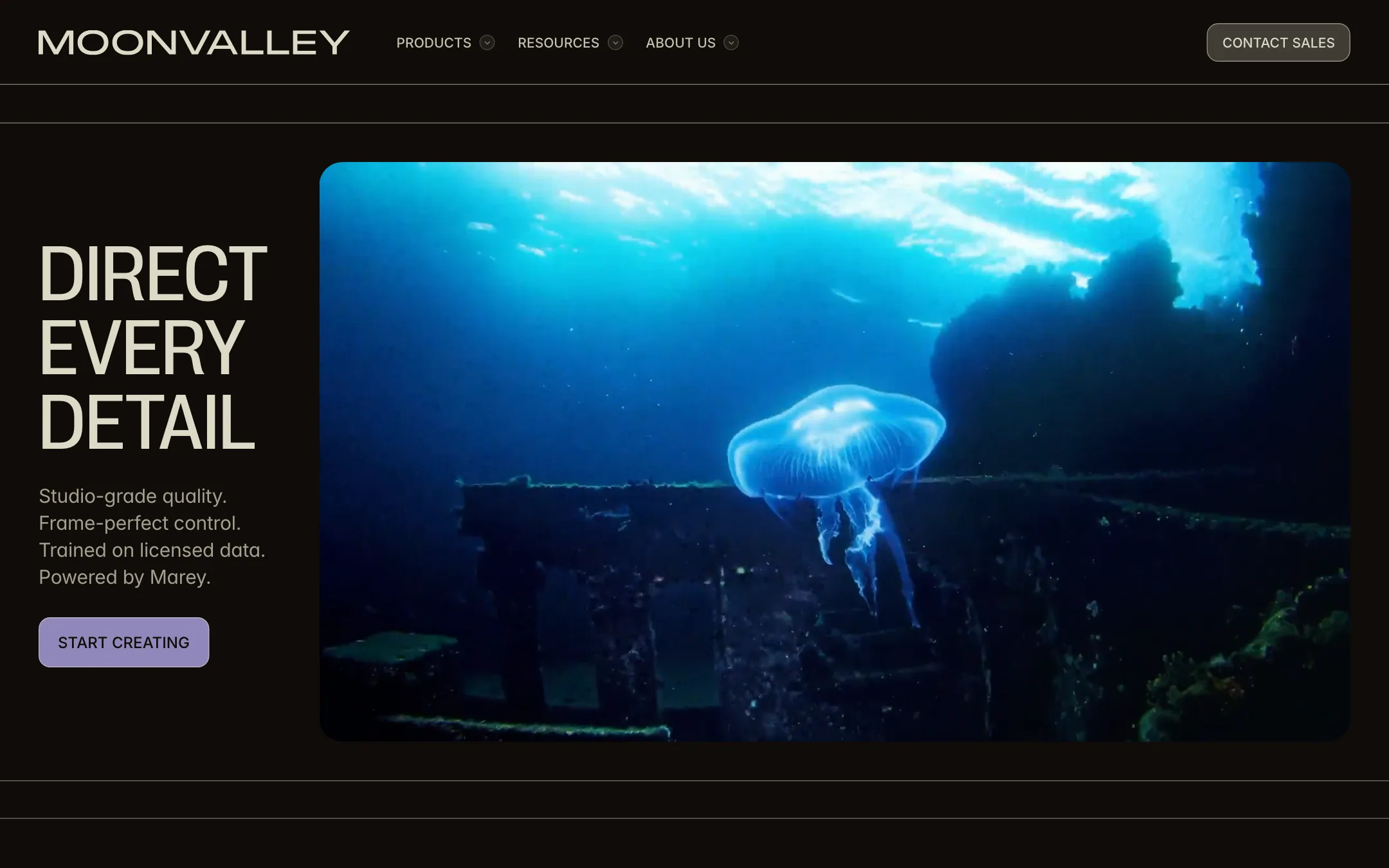
- The homepage still has a Start Creating button. It leads to app.moonvalley.com/signup, which redirects to the notice that self-serve plans are gone.
- The shutdown notice is dated July 2026 on the page but gives March 23, 2026 as the date renewals stopped.
- The navigation includes a Pricing link that points back to the homepage.
- The public API page is a waitlist, while the same site sends you to fal.ai and ComfyUI to use Marey today.
Moonvalley vs Runway, Luma and the big labs
Moonvalley competes with tools that sell to filmmakers, such as Runway and Luma, and with the big-lab models from Google and OpenAI. The comparison comes down to three things.
Licensing. This is Moonvalley’s clearest difference. Most video models are trained on large web-scale datasets, and their makers say little about where the footage came from. Moonvalley says Marey used only licensed footage. If a client, a broadcaster or a studio legal team asks where your AI footage came from, that answer is easier to give.
Control. Runway and Luma also offer camera and motion tools, and so do several Chinese models. Marey’s list of controls is long and aimed squarely at directors: trajectory drawing, pose transfer, keyframes and camera moves from a single still. How much of that you can reach depends on the route you use, since third-party endpoints do not always expose every control.
Access. Here Moonvalley is now weakest. Runway, Luma, Veo and Sora all have consumer apps or simple paid tiers. Moonvalley sends individuals to fal.ai or ComfyUI and everyone else to a sales form. If you want to sign up today and start generating in a browser, the competitors are easier.
What we would like to see
Moonvalley’s site still sells the Marey app to creators while the app is closed to them. A clear page that says who Marey is for today, which controls are available on fal.ai and ComfyUI, and how enterprise pricing works would help buyers a lot. Until then, read the shutdown notice before you click Start Creating, and confirm with Moonvalley’s team which features your plan or partner route includes.
Who should still look at Moonvalley
Moonvalley is still worth a look if you are:
- A production company or agency whose clients ask hard questions about training data.
- A developer who wants Marey in a ComfyUI pipeline next to other tools.
- A filmmaker happy to pay per clip on fal.ai for shots where licensing matters more than price.
For everyone else, one of the self-serve generators will be quicker to start with.
Verdict
Marey is a serious model with a clear pitch: licensed training data and director-grade controls. For studios and brands that need AI video their legal team will sign off on, Moonvalley is worth a sales call.
For individual creators, it is now a model you reach through fal.ai or ComfyUI, paid per clip, without the full app. If you want a self-serve subscription with similar camera and motion control, look at Runway first.